
The basics of group prayer
Group prayer gets awkward when people don't know what's expected. Will I be called on? How long should I pray? Do I have to use special words? A good leader answers those questions before anyone has to ask.
Before you start, say three things out loud:
- How it will work ("I'll start, anyone can pray after that, and I'll close").
- That short prayers are welcome ("One sentence is perfect").
- That nobody has to pray out loud ("It's completely fine to pray silently").
Then go first, and keep it short and plain. People copy the leader. If you pray three simple sentences, others will believe they can too.
For where two or three are gathered together in my name, there am I in the midst of them.
A prayer to begin group prayer
Lord, thank You that You're here with us, and that You love to hear from Your children. We don't need fancy words. Help us talk to You honestly, the way we'd talk to someone we trust.
Holy Spirit, guide what we pray. Give the nervous ones courage and the talkative ones patience. Let this time draw us closer to You and to each other. In Jesus' name, amen.
Five group prayer formats that work
Switching formats now and then keeps group prayer from becoming the same five people praying the same way every week.
1. Popcorn prayer
The leader opens, then anyone prays whenever they're ready, in no order, as many times as they want. Short prayers "pop" up around the room. It works best when you suggest a topic for each round, like thanks, then requests, then the wider world. Close when the room goes quiet for a while.
2. Pairs and triads
Split into twos or threes. Each person shares one request, and the others pray for it. This is the single best format for groups where people are shy, new, or don't know each other well. Everyone gets prayed for by name, and nobody has to pray in front of the whole room.
3. One-sentence prayers
Go around the circle and invite each person to pray one sentence, or to say "pass." Give a prompt: "Thank God for one thing from this week" or "Pray for the person on your left." It's gentle, quick and gets almost everyone praying out loud, often for the first time.
4. ACTS
Move through four kinds of prayer in order, with a minute or two each:
- Adoration: praise God for who He is.
- Confession: a time of silent confession, so no one feels exposed, followed by thanks for His forgiveness.
- Thanksgiving: thank Him for what He's done.
- Supplication: bring requests for yourselves and others.
ACTS keeps a group from jumping straight to requests, and it gives structure to people who aren't sure what to say.
5. Praying through requests with a scribe
One person writes down each request as it's shared. Then the scribe reads them back one at a time, and someone volunteers to pray for each. The list becomes the group's record, so next week you can ask what happened and give thanks for answers.
Not sure which to pick?
For a new group, start with pairs or one-sentence prayers. Once people are comfortable, try popcorn prayer. Use ACTS when prayer starts to feel like a shopping list.
Gathering prayer requests without losing the evening
Sharing requests can easily take forty minutes and leave five for praying. A few habits keep it in balance.
- Ask for requests in a sentence or two. The full story can wait for afterward.
- Ask people to share about themselves or people close to them, not secondhand news.
- Pray as soon as a request is shared, rather than collecting a long list first.
- Start with answered prayers from last week. It sets a hopeful tone.
If your group struggles to put requests into words, our prayer request examples can help.
Handling silence in group prayer
Silence is not failure. Often it's people thinking, or praying quietly. Give it longer than feels comfortable before you step in.
- 1
Wait a little longer
Ten or fifteen seconds of quiet feels long to a leader, but it's normal. Someone usually fills it.
- 2
Give a specific prompt
"Let's thank God for one thing" is much easier to respond to than "Does anyone want to pray?"
- 3
Name the silence kindly
"Let's take a minute to pray quietly, and then I'll close." Silent prayer is real prayer.
- 4
Close without fuss
If nobody else prays, that's okay. Pray a warm closing prayer and try a different format next time.
Long prayers and oversharing
Every group eventually has someone whose prayers go on for five minutes, or someone who shares more than the room can hold. Both usually come from a good place, so handle them gently.
For long prayers, set expectations for everyone, not one person: "Let's keep prayers to a sentence or two tonight so everyone gets a turn." If it keeps happening, have a quiet word afterward and thank them for their heart for prayer before asking them to help make room for others.
For oversharing, thank the person, pray for them right then, and offer to talk more afterward. If someone shares details about another person's private situation, steer gently: "Let's pray for her and keep the details between her and God."
For a crisis, stop and pray for that person right away, then follow up in private. Some situations need more than a group can give, like a pastor, a counselor or emergency help. Part of caring for someone is helping them get it.
Keeping prayer requests confidential
People will only share honestly if they trust the group. Say the rules out loud, and say them often.
- What's shared in the group stays in the group.
- Don't pass a request on, even "for prayer," without asking the person first.
- Don't write sensitive requests in a group chat unless the person says it's okay.
- A good test: would they be glad to know you said this?
A talebearer revealeth secrets: but he that is of a faithful spirit concealeth the matter.
Online prayer groups
Online prayer groups let friends in different cities, people who can't leave home, and busy parents pray together. A video call needs a little more structure than a living room, because people can't read the room as easily.
- Pray in a clear order (follow the gallery, or the leader names the next person) so people don't talk over each other.
- Ask everyone to type requests in the chat. It saves time, and the leader can read them back.
- Use breakout rooms of two or three for longer prayer times.
- Keep cameras optional. Some people pray more freely with theirs off.
- Keep it shorter than in person. Thirty to forty minutes is plenty on a screen.
Opening an online prayer group
Lord, we're in different homes tonight, maybe in different time zones, but You're with every one of us. Help us listen well, pray honestly, and feel close to each other across the distance. Amen.
Keeping group prayer going between meetings
The best prayer groups don't stop praying when the meeting ends. A short message midweek tells someone they haven't been forgotten.
Praying for your interview this morning. God is with you in that room.
Thinking of your mom today. How did the appointment go?
Just prayed for you. No need to reply.
Any update on what you shared Thursday? Still praying.
Some groups keep a shared list in a group text or a private prayer app, and check it each week for answers. Whatever you use, follow up in person. Asking "How did it go?" is often the most loving thing a group can do.
Bear ye one another's burdens, and so fulfil the law of Christ.
Prayers to start and finish group prayer
Short lines you can use to open or close, whatever format you choose.
- Lord, we're here together. Teach us to pray. Amen.
- Holy Spirit, help us pray for what's on Your heart tonight. Amen.
- Father, thank You for hearing every prayer, spoken or silent. Amen.
- Jesus, You know each need we brought. We trust You with them. Amen.
- God, help us keep praying for each other all week. Amen.
Closing group prayer
Father, thank You for listening tonight. We leave everything we prayed in Your hands, because they're better hands than ours. Help us keep praying for each other this week, and to notice when You answer. In Jesus' name, amen.
Running a longer prayer meeting?
See our opening and closing prayers for a prayer meeting, with a simple order for an hour.
Coming soon to iPhone
Give your prayer group a home between meetings
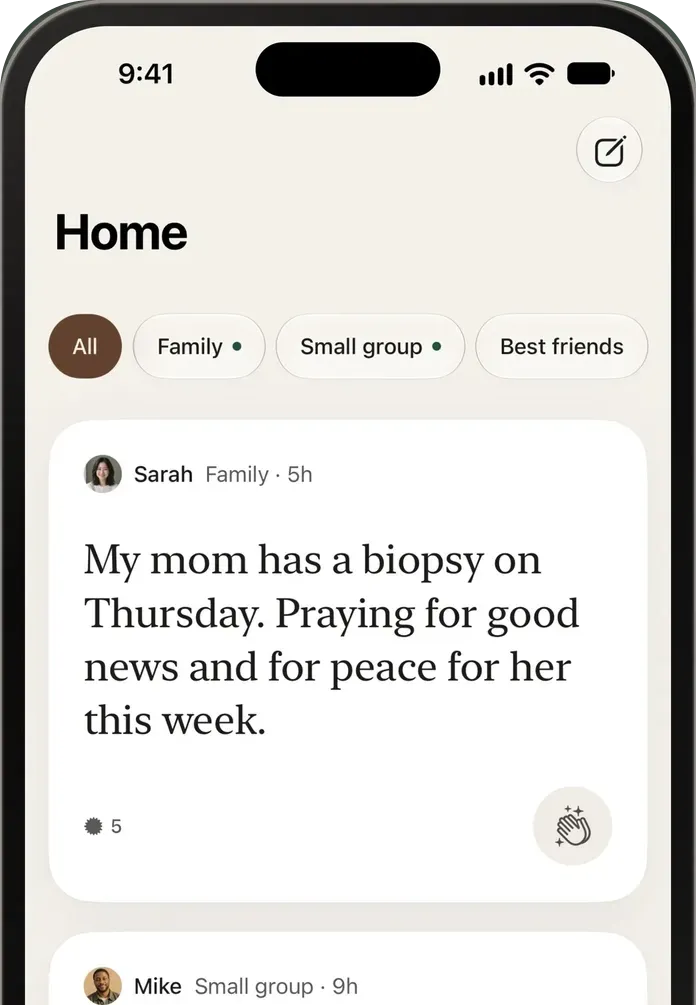
PrayerBoard is a private circle for your group. Share prayer requests during the week, pray with a tap, see who prayed, and share answered prayers with everyone.
Free, with no ads. We'll only email you about the launch.
Questions people ask
How do you lead group prayer for beginners?
Explain exactly what's going to happen, model a short and plain prayer yourself, and tell people it's fine to pray silently. One-sentence prayers or praying in pairs are the easiest places to start.
What is popcorn prayer?
Popcorn prayer is when anyone in the group prays a short prayer out loud whenever they're ready, in no particular order. The leader opens and closes, and people can pray as often or as little as they like.
How do you get people to pray out loud in a group?
Make it small and safe. Split into pairs or threes, suggest a single sentence, and never call on someone who hasn't agreed. Most people start praying aloud once they've heard others pray simply.
How do online prayer groups work?
Most meet on a video call at a set time, share requests in the chat, and pray in a clear order or in breakout rooms. Between calls, members keep praying through a group text or a private prayer circle.
What do you say to close group prayer?
Thank God for listening, leave the requests in His hands, and ask Him to help the group keep praying for each other. Some groups finish by praying the Lord's Prayer together.


