
What is a prayer chain?
A prayer chain is a promise between a few people: when one of us needs prayer, the rest of us will hear about it quickly and pray. It got its name from the old phone tree, where each person called the next one down the list, link by link.
The idea is much older than the telephone. Paul asked churches to pray for him, and he prayed for them by name. Christians have always carried each other's needs to God, especially when someone is too tired or too scared to pray for themselves.
Bear ye one another's burdens, and so fulfil the law of Christ.
A prayer chain can belong to a whole church, a small group, a family or a few close friends. Some are called a prayer team, which usually means the same thing with a little more structure: a coordinator, a few people who follow up, and a rhythm for meeting or checking in. Whatever you call it, the heart of it is the same. Someone shares a need, people pray, and someone follows up.
Who to include in a prayer chain
The people matter more than the method. A good prayer chain is made of people you'd trust with your own hard news.
- People who will actually pray. Not everyone who says yes will follow through. Invite people you've seen pray, or ask plainly: "Would you be willing to pray within a day when a request comes in?"
- People who can keep things private. This is the one that matters most. One person who passes requests on as gossip can make everyone stop sharing.
- A mix of ages and seasons. Retirees often have time to pray during the day. Parents of young kids and people with demanding jobs bring different eyes to the same request.
- Fewer people than you think. Five to twelve is a good start. You can always add people later, and a small chain feels safe enough for people to share real things.
Invite people one at a time, in person or with a personal message. A sign-up sheet gets you names; a personal ask gets you people who understand what they're saying yes to.
How prayer requests travel: phone tree, group text, email or an app
There's no single right way. Pick the one your people already use, and stick to one place so nothing gets lost.
Phone tree
The coordinator calls two or three people, and each of them calls two or three more. It's personal and works well for people who don't text. The downside is that details change as they're passed along, and one missed call can stop the chain.
Group text
Fast, free and already on everyone's phone. It works well for small groups. Bigger groups find that requests get buried under replies, and it's hard to tell who has prayed or what the latest update is.
Email list
Good for a church-wide prayer chain and for people who like to read and pray at a set time each day. It's slower, and updates often get lost in crowded inboxes.
A prayer chain app
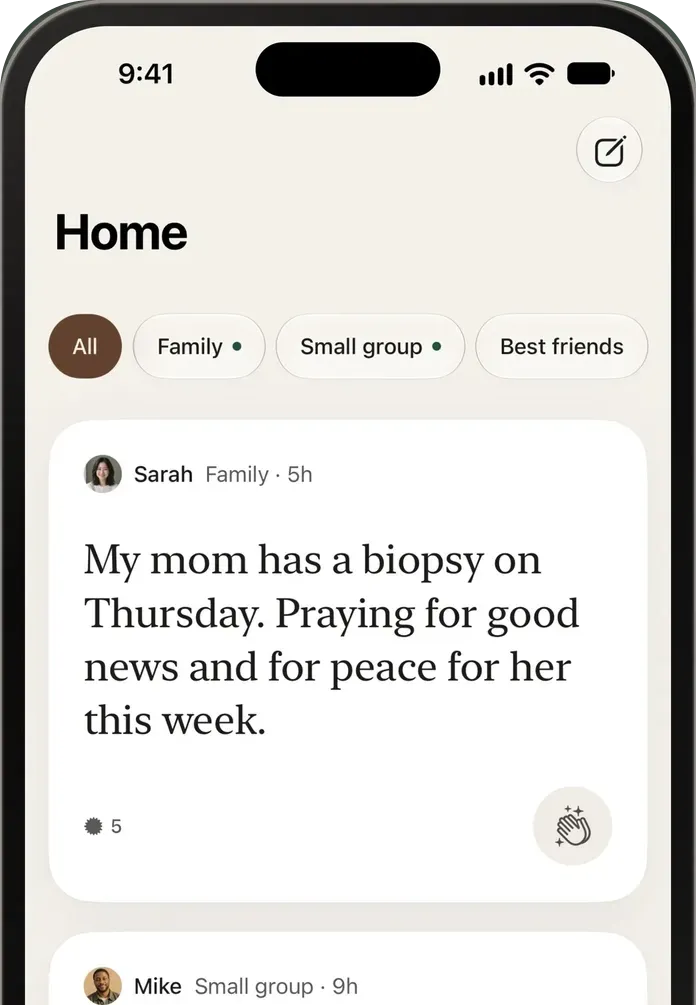
An online prayer chain in an app keeps every request in one place, with updates attached to the request instead of scattered through a thread. Many online prayer groups use one for that reason. It does ask everyone to download something, which is a real cost for some groups. PrayerBoard, the app we're building, is one option made for small private circles; a shared group text is still a perfectly good place to begin.
Choose one home
Whatever you pick, make it the only place requests live. When some come by text, some by email and some in the church lobby, people miss things and stop trusting the chain.
Privacy and consent on a prayer chain
A prayer chain only works when people feel safe. Get this right and people will share what they're really carrying.
A talebearer revealeth secrets: but he that is of a faithful spirit concealeth the matter.
- 1
Always ask before passing a request on
If a friend tells you about their mom's diagnosis, ask, "Would it be okay if I shared this with our prayer chain?" Never assume. News belongs to the person it's about.
- 2
Ask how much they want shared
Some people are fine with everything. Others would like only "Please pray for Sarah's family this week." Use their words if you can, and keep it to what they agreed to.
- 3
Leave out the details nobody needs
God knows the details. The chain needs enough to pray, not a medical chart or the full story of a marriage. A sentence or two is plenty.
- 4
Agree that requests stay in the chain
Make it a simple rule everyone hears when they join: we don't forward requests, screenshot them or mention them to others without asking.
- 5
Let people share privately
Some needs are too tender to name. It's fine to post "Please pray for me this week; it's something I can't share yet." People can pray faithfully without knowing why.
Prayer chain message templates
Copy these and fill in the brackets. Short, clear messages get prayed for. Long ones get skimmed.
Posting a new request
Prayer request for [Name], shared with their permission: [one or two sentences about the need]. Please pray for [something specific, like peace, wisdom or strength]. I'll share an update by [day].
Hi everyone, could you pray for me this week? [Short description]. Thank you for carrying this with me.
Please pray for [Name]'s family. They'd rather not share details yet, but they're grateful for your prayers.
Sharing an update
Update on [Name]: [what's changed]. Please keep praying for [what's still needed]. Thank you for praying.
Answered prayer! [Name] [what happened]. Thank you to everyone who prayed. God is good.
Quick update: no news yet on [Name]. They said your prayers have meant a lot. Please keep praying for patience while they wait.
For more wording ideas, our guide to prayer request examples has forty you can borrow.
Prayer team roles
A small chain can run on one coordinator. A larger prayer team goes better when a few people share the work.
- Coordinator. Receives requests, checks permission, writes the message and sends it out. Ideally this is one or two people so there's a clear front door.
- Follow-up person. Checks in a week or two later with whoever asked for prayer, and posts the update. This is the role most chains are missing.
- Pray-ers. Everyone else. Their only job is to pray, and to let the group know they did, even with a simple "Praying."
- Encourager. Optional, but lovely. Someone who sends a card, drops off a meal or writes a note when a request is heavy.
Rotate the coordinator role every few months if you can. It keeps one person from burning out and helps more people feel ownership.
Updates and answered prayers
Updates are what turn a list of requests into a story you're living together.
When nobody hears what happened, people slowly stop praying. They aren't uncaring; they just don't know whether the need is still there. A short update, even "Still waiting, please keep praying," keeps everyone connected.
When a prayer is answered, say so, and say thank you. Answered prayers build faith, and they remind the chain that their prayers were part of something real. When the answer is hard, or isn't the one you hoped for, share that too, with the person's permission. A prayer chain that only reports good news teaches people to hide the hard parts.
Set a follow-up date
When you post a request, say when you'll check back. It gives the follow-up person a reason to ask, and it gives everyone a reason to keep praying.
Keeping your prayer chain from going stale
Most prayer chains don't end. They just go quiet. A few small habits keep yours alive.
- 1
Close old requests
Once a month, look at open requests and ask for an update or mark them as answered. A list that only grows feels heavy.
- 2
Let people say they prayed
A quick "Prayed for you this morning" encourages the person who asked and reminds others to pray too.
- 3
Share small requests too
If the chain only lights up for emergencies, people feel they need a crisis to ask. Job interviews and hard conversations count.
- 4
Pray together now and then
Meet in person or on a call a few times a year. It reminds everyone that these are people, not notifications. Our guide on how to lead group prayer can help.
- 5
Check in with the members
Once a year, ask who'd like to keep going. Letting people step away graciously keeps the chain honest.
Prayers for your prayer team
For the first time you meet, or any time the chain needs a fresh start.
A prayer for a new prayer chain
Father, thank You for each person who said yes to praying. You know every need that will come through this group before we do. Make us faithful, quick to pray and slow to talk.
Help us carry each other's burdens with gentleness. Guard the things people trust us with, and let every person who asks for prayer feel loved and not exposed. When You answer, help us notice and give You thanks. Amen.
When a request comes in
Lord, You already know what our friend is facing. We bring them to You now. Give them what they need today, whether that's strength, peace, wisdom or simply rest. Let them know they aren't alone. Amen.
For the coordinator
God, thank You for the one who gathers our requests and sends them out. Give them wisdom about what to share and what to keep. Protect them from feeling the weight of every need alone, and refresh them when they're tired. Amen.
When the chain feels quiet
Jesus, we've grown quiet with each other. Stir us up again. Give us the courage to share what we're carrying, and the faithfulness to keep praying for what others have shared. Make this group a place of real love. Amen.
Giving thanks for answered prayer
Father, we asked and You heard us. Thank You. Help us remember this the next time we're tempted to doubt, and help us keep praying with the same hope for every request still waiting. Amen.
Coming soon to iPhone
A prayer chain that lives in one place
PrayerBoard is coming soon: a private circle where your prayer team can share requests, pray with a tap, see who prayed and celebrate answered prayers together.
Free, with no ads. We'll only email you about the launch.
Questions people ask
What is a prayer chain?
A prayer chain is a group of people who commit to praying when someone shares a request, and to pass that request on to the rest of the group. It used to run by phone; today most prayer chains use a group text, email or an app.
How many people should be on a prayer chain?
Start with five to twelve people who will actually pray. A small chain that responds every time is better than a big list where nobody is sure who saw the request.
How do you start an online prayer chain?
Pick one place for requests to live, such as a group text, an email list or a private prayer app, and invite people personally. Agree on a few simple rules up front: ask before sharing anyone's request, keep details brief, and post an update when something changes.
Is it okay to share someone's prayer request with the prayer chain?
Only if they've said yes. Ask them first, and ask how much they'd like shared. Some people are glad for everyone to know, and some would rather only their first name and a general need be passed on.
What should a prayer chain message say?
Who the request is for, what to pray for in a sentence or two, and when you'll share an update. Leave out medical details and anything the person didn't agree to share.


