
How to use this Bible study on prayer
This study is built for any small group: a church home group, a campus Bible study, a few friends around a kitchen table, a family, or a group that meets on a video call. Nobody needs to prepare except the leader, and nobody needs to have prayed out loud before.
Each week follows the same simple shape:
- Open with a short prayer.
- Read the passage aloud, twice if it's short. Different voices help.
- Read the short introduction, or put it in your own words.
- Talk through the questions. Pick the ones that fit your group; you don't need them all.
- Explain the practice for the week, and try a small piece of it together before you leave.
- Close by praying for each other.
Any Bible translation works. The verses quoted below are from the King James Version, but reading from whatever your group already uses is better than switching.
Week 1: Jesus teaches us to pray
Read: Matthew 6:5–13
But thou, when thou prayest, enter into thy closet, and when thou hast shut thy door, pray to thy Father which is in secret; and thy Father which seeth in secret shall reward thee openly.
Jesus' friends had grown up praying. They knew the psalms and the prayers of the synagogue. Still, they watched Him pray and asked Him to teach them (Luke 11:1). In Matthew 6 He warns against two things: praying to impress people, and piling up words as if God needs persuading. Then He gives them a prayer that is short, plain and complete. It starts with God (His name, His kingdom, His will) before it turns to our needs: bread for today, forgiveness, and help when we're tempted.
The surprise is how simple it is. Jesus doesn't teach a technique. He teaches us to talk to a Father who already knows what we need.
Questions to discuss
- When you were growing up, what did prayer look or sound like? What has stuck with you, good or bad?
- Jesus warns about praying to be seen by others. Where might that show up for us today, even in a small group?
- Verse 8 says the Father knows what we need before we ask. If that's true, why do you think Jesus still tells us to ask?
- The prayer begins with God's name, kingdom and will before it gets to our needs. What would change if your prayers started there?
- "Give us this day our daily bread" is a prayer for today, not next year. What's one need you'd bring to God just for today?
- Which line of the Lord's Prayer is hardest for you to pray honestly right now, and why?
Practice this week: pray the Lord's Prayer slowly
Once a day, pray the Lord's Prayer one line at a time. After each line, stop and put it in your own words. "Your kingdom come" might become a prayer for your workplace or your family. It takes about five minutes. Next week, share which line meant the most.
Week 2: Bringing everything to God
Read: Philippians 4:4–7
Be careful for nothing; but in every thing by prayer and supplication with thanksgiving let your requests be made known unto God.
Paul wrote this letter from prison, not from a comfortable desk. When he tells the church in Philippi not to be anxious, he isn't speaking from a life without problems. His answer to worry is prayer about everything, big and small, mixed with thanks.
Notice what he promises and what he doesn't. He doesn't promise that every request will be granted the way we want. He promises God's peace, a peace that doesn't make sense on paper, standing guard over our hearts and minds.
Questions to discuss
- What kinds of things do you find easy to pray about? What do you tend to keep to yourself, as if it's too small or too messy for God?
- Paul says to pray about "every thing." What would it look like to actually do that on an ordinary Tuesday?
- Why do you think he includes thanksgiving alongside requests? How does thanking God change the way you worry?
- Verse 7 describes a peace that "passeth all understanding." Have you ever felt peace that didn't match your circumstances? What was that like?
- Paul was in prison when he wrote "Rejoice in the Lord alway." Does that make his words easier or harder to hear?
Practice this week: turn worries into prayers
Each time you notice yourself worrying, turn it into a one-sentence prayer and add one thing you're thankful for. "Lord, I'm worried about this meeting. Thank You for my job." Some people jot them on their phone. Next week, talk about what you noticed.
Week 3: Praying for each other
Read: James 5:13–16, then Colossians 4:2–4 and Ephesians 6:18
Confess your faults one to another, and pray one for another, that ye may be healed. The effectual fervent prayer of a righteous man availeth much.
Prayer in the Bible is rarely a private hobby. James pictures a church where people who are suffering pray, people who are glad sing, and people who are sick call others to come and pray over them. He even tells us to confess our faults to one another, which only works in a group where people trust each other.
Paul asks for prayer himself in Colossians 4:2–4, and in Ephesians 6:18 he tells the church to keep praying for all the saints. The apostle who wrote so much of the New Testament still needed his friends to pray for him.
Questions to discuss
- Has anyone ever told you they were praying for you at just the right time? What did it mean to you?
- James says the sick should "call for" others to pray. Why is it often hard to ask for prayer?
- What would need to be true of this group for people to feel safe sharing what's really going on?
- In Colossians 4:3–4, Paul asks for an open door and the words to speak clearly. What does it tell you that he asked for prayer about his work, not only his troubles?
- What's the difference between saying "I'll pray for you" and actually doing it? What helps you follow through?
- How could we pray for each other between meetings, not just when we're together?
Practice this week: pray for one person every day
Before you leave, pair up. Swap one specific request with your partner, and pray for them every day this week. Send them one short message midweek to say you're praying or to ask how it's going. Next week, check in about it.
Week 4: When prayer feels unanswered
Read: Luke 18:1–8 and Psalm 13
And he spake a parable unto them to this end, that men ought always to pray, and not to faint;
Everyone who prays long enough runs into this: you asked, and nothing seemed to happen. Jesus knew His followers would face it, so He told a story about a widow who kept going back to an unjust judge until he gave in. The point isn't that God is like the judge. It's the opposite: if even a bad judge eventually listens, how much more will a good Father who loves His children?
Psalm 13 shows what that kind of persistence sounds like from the inside. It opens with "How long?" four times. It doesn't hide the frustration. And yet by the end, the writer chooses to trust and to sing, even before anything has changed.
How long wilt thou forget me, O LORD? for ever? how long wilt thou hide thy face from me?
Questions to discuss
- Is there something you've prayed about for a long time without seeing an answer? Share as much or as little as you'd like.
- Jesus tells this story so we will "not faint," or lose heart. What makes you most tempted to give up on praying about something?
- How is God different from the judge in the story? Why does that difference matter?
- Psalm 13 is honest, even blunt, with God. Do you feel free to pray like that? Why or why not?
- The psalm turns toward trust before anything changes. What helps you trust God while you're still waiting?
- Looking back over these four weeks, what has changed in the way you pray?
Practice this week: write your own 'How long?' prayer
Use Psalm 13 as a pattern. Write a few honest lines about something you're waiting on, then a line or two of trust, even if it feels small. Keep it somewhere you'll see it. If your group continues, start a shared list of long-term requests and check on them every month.
Prayers for the study
Use these to open and close the sessions, or as a starting point for your own.
A prayer to begin the study
Lord, we want to learn to pray, and we're not sure we know how. Thank You that You don't need us to be good at it. You just want us to come.
Over these four weeks, teach us through Your Word and through each other. Make prayer less like a duty and more like talking to a Father who's glad to hear from us. In Jesus' name, amen.
Opening any week
Holy Spirit, You help us when we don't know what to pray. Help us now as we read and talk. Make this passage come alive for us, and let it change how we pray this week. Amen.
Closing any week
Father, thank You for what You showed us tonight. As we try this week's practice, help us remember it and stick with it, even when we forget a day. Hear the prayers we bring for each other. Amen.
Closing the last week
Lord, thank You for these four weeks. Thank You for every honest question and every prayer prayed in this group. Keep us praying, for ourselves, for each other and for the world, long after this study ends. Amen.
If you're leading
- 1
Read ahead, but don't over-prepare
Read the passage a couple of times during the week and pick the three or four questions you most want to get to. That's enough.
- 2
Let the silence sit
After you ask a question, count to ten in your head before you rescue it. People need time to think, especially about prayer.
- 3
Pray more than you talk about praying
It's easy for a study on prayer to become all discussion. Protect at least fifteen minutes at the end to pray together. Our guide on how to lead group prayer has simple formats that help quieter people join in.
- 4
Ask about last week's practice
Start each session by asking how the practice went. Make it fine to say "I forgot." The point is to keep trying, not to keep score.
- 5
Handle hard stories gently
Week 4 can bring up real grief. Thank people for sharing, don't rush to explain why prayers weren't answered, and offer to pray with anyone afterward.
Coming soon to iPhone
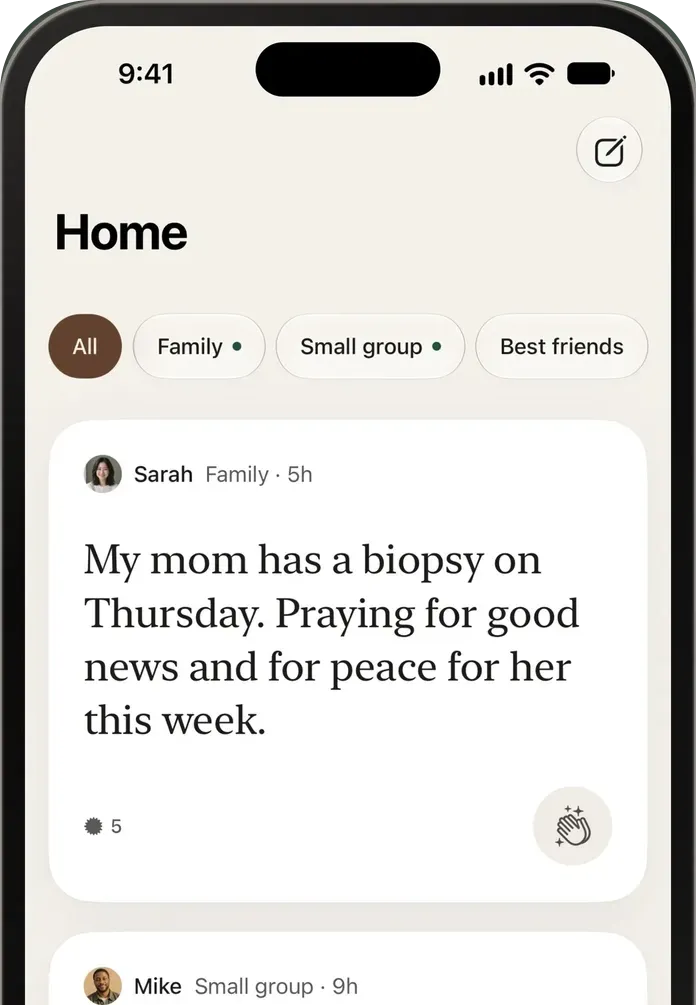
Practice praying for each other between weeks
PrayerBoard gives your small group a private circle for prayer requests. Share what's going on, see who prayed, and mark answers so you can talk about them at the next study.
Free, with no ads. We'll only email you about the launch.
Questions people ask
What is a good Bible study on prayer for a small group?
Start with the passages where Jesus and the apostles teach directly about prayer: Matthew 6:5–13, Philippians 4:4–7, James 5:13–16 and Luke 18:1–8. Pair each passage with honest questions and something to practice that week, so the group prays and doesn't only talk about prayer.
How long does each session of this study take?
Plan on about an hour: ten minutes to read the passage, thirty to forty minutes of discussion, and ten to fifteen minutes to pray together. You won't need every question every week.
Do I need training to lead a Bible study on prayer?
No. You need to read the passage ahead of time, ask the questions, and listen well. It's fine to say you don't know an answer and come back to it next week.
Can we do this study online?
Yes. Share the passage in the chat before you start, have one person read it aloud, and use breakout rooms of two or three for the prayer time so everyone gets a turn.


